Deepseawaters Calendar
By Month - Jan | Feb | March |april | May | June | Aug | Sep | Oct | Nov | Dec
Deepseawaters Calendar - September
In the Florida Keys National Marine Sanctuary, scientists look for possible spawning of elkhorn and staghorn corals (Acropora palmata) and (A. cervicornis) and star coral spawning (Montastrea spp).
Annual coral spawning cruise in the Flower Garden Banks National Marine Sanctuary. Each year eightnights after the full moon in August between the hours of 8 -9 p.m.; several species of coral release their gametes. The event has been described as an "underwater snowstorm." Recreational divers first discovered this phenomenon within the sanctuary in 1990. In the Florida Keys, several coral species have a spectacular form of reproduction &endash; they spawn synchronously, late at night, often during the week after the full moon during August or September..
Blue and humpback whales return from Mexico and Central America to their summer feeding grounds in the Gulf of the Farallones and Cordell Bank and Monterey Bay Sanctuaries. Through October.
Common Murre chicks have fledged and are following their dads around the sanctuary learning how to catch food. Gulf of the Farallones and Cordell Bank Sanctuaries. Through September.
Gulf of the Farallones sanctuary personnel perform monitoring intertidal of invertebrates and algae on the Farallon Islands.
White shark season at the Farallon Islands as molting elephant seals start to concentrate at haul out sites. Through November. Gulf of the Farallones National Marine Sanctuary.
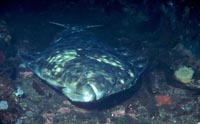 Sportfisher folk catch halibut in Tomales Bay and striped bass from coastal beaches, Gulf of the Farallones Sanctuary.
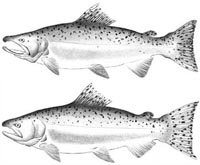 Pacific salmon start their spawning migration up the Sacramento River system. Northern Monterey Bay and Gulf of the Farallones National Marine Sanctuaries through September.
Whale sharks occasionally seen in Flower Garden Banks Sanctuary during warm months of August through early October.
From June through August many species of jellies appear and drift in the nutrient rich waters in the Cordell Bank Marine Sanctuary. Black footed Albatross are most abundant in Sanctuary waters . While Sooty Shearwaters blanket the food rich waters of the California Coast by the millions through September as they continue on their circumnavigation of the Pacific ending up in Chile to nest.
Calm winds and seas become more frequent near the end of summer in Channel Islands National Marine Sanctuary.
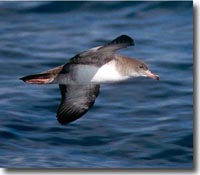 Pink-Footed Shearwaters(Puffinus creatopus) and Sooty Shearwaters (Puffinus griseus) visit the Santa Barbara Channel from the southern hemisphere (May through October).
Ashy Storm-Petrels (Oceanodroma homochroa) and Black Storm-Petrels (Oceanodroma melania) visit the Santa Barbara Channel (mid-May to mid-October).
Endangered Least Terns (Sterna antillarum browni) can be seen in the Channel Islands region (May through August).
Red-Necked Phalaropes (Phalaropus lobatus) can be seen in the Santa Barbara Channel in the spring (April and May) and fall (August through October).

 Deep Sea Crabs
 Deep Sea Shrimps
 Deep Sea Lobsters