Deep Sea Snakes
Sea snakes are marine reptiles. They are mainly found in tropical waters, from the eastern coast of South Africa, to Panama. In Australia they occur off the west coast as far south as Pt Hedland, right across the top end, and all the way down the east coast.
There are around 55 species of sea snake found in the world, around 22 of these are found in Western Australian waters.
Sea snakes have evolved from the earth bound elapids and as such are generally venomous and have hollow fixed front fangs. As they have adapted to life in the water they have developed paddle tails and a keel which keeps them stable in the water but makes it very difficult for them to move on land. They shed their skin every two to six weeks. This process helps them to get rid of barnacles and other sea parasites which may attach to them.
Characteristics
They breathe air and have nostril valves which close under water. They excrete salt from a gland in the mouth under the tongue. They bear live young in the water after a gestation period of from four to eleven months. The males have two penises named hemipenes, however, only one is used at each mating. The young are independent from the time of birth.
There is a popular misconception that sea snakes have tiny mouths and are, therefore, not dangerous to man. This is not true; a sea snake can open its mouth to swallow a fish two to three times bigger than the diameter of its neck. They are able to dislocate their jaw in the same way that land based snakes do. It is true however, that the primary purpose of venom in sea snakes is to subdue prey, rather than for defense. Because of this most bites delivered to humans are blanks, that is, although they bite, often they do not release venom.
Sea snakes are extremely placid creatures and there has never been a recorded human death due to a sea snake bite recorded in Australia, although most species are highly venomous. They do become more aggressive during the mating season which is during the winter months, and they are extremely curious. They have been known to bite at scuba divers and can fasten onto a flipper. Most bites recorded are to fishermen handling fishing nets which have captured sea snakes as by-catch. It should never be forgotten that sea snakes are venomous and should always be handled with extreme care. Where ever possible they should be left untouched until an experienced snake handler is called to move them.
A non-venomous sea snakes found off the west coast is the turtle headed (emydocephalus annulatus) which eats fish eggs. They have adapted their mouths to form a scraping plate, their mouths are now fused and they have lost the ability to produce venom. Some other species are either only mildly venomous or not venomous.
Habit
Sea snakes mainly inhabit the shallow waters around our shores and are most likely to be found on land following violent sea storms, or as a result of illness or injury.
Diet
Most sea snakes eat fish, fish eggs and eels, although the yellow bellied sea snake eats plankton.
Location or Region Found
There are five major groups of sea snake found in the world. The two major groups are the Hydrophiidae and the Laticaudidae. Hydrophiidae are the true sea snakes and the only species found breeding in Australian waters. The Laticaudidae are the sea kraits. Two of this family is found in Australia's northern most waters between Papua New Guinea and New Caledonia.
Different Kind of sea snakes have been arranged here in alphabetical order by scientific name.
| Image | Common Name | Scientific Name | Bite |
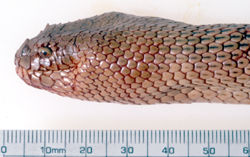 |
H orned Sea Snake | Acalyptophis peronii | potentially dangerous |
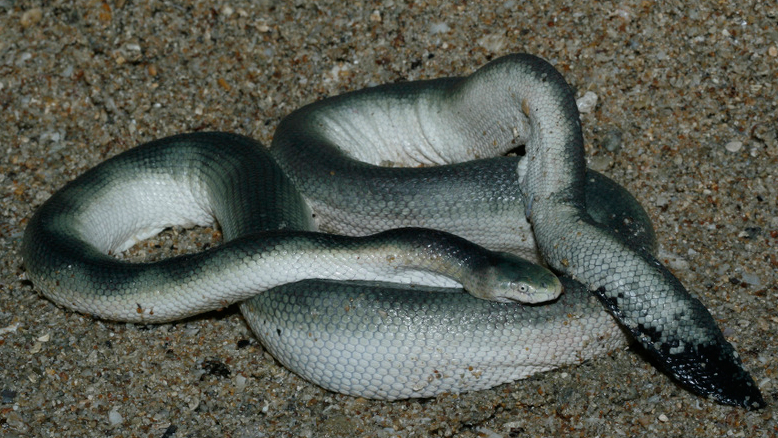 |
Viperine Sea Snake | Thalassophina viperina | well known for its strike, but not bite |
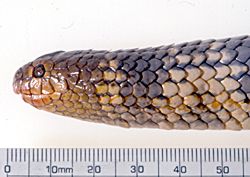 |
Stagger-banded Sea Snake | Aipysurus eydouxii | weakly venomous |
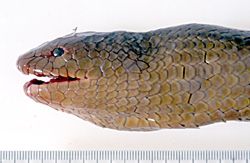 |
Olive Sea Snake | Aipysurus laevis | potentially fatal |
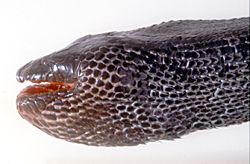 |
Stokes' Sea Snake | Astrotia stokesii | potentially fatal |
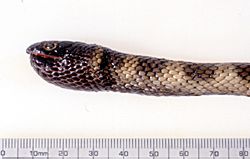 |
Spectacled Sea Snake | Disteira kingii | potentially dangerous |
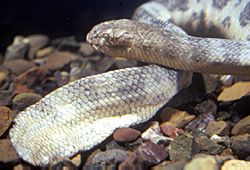 |
Olive-headed Sea Snake | Disteira major | potentially fatal |
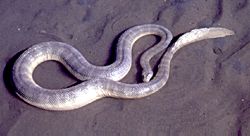 |
Beaked Sea Snake | Enhydrina schistosa | potentially fatal |
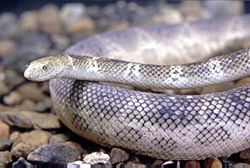 |
Elegant Sea Snake | Hydrophis elegans | potentially fatal |
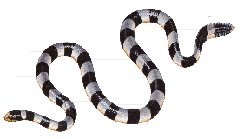 |
Yellow-lipped sea snake | Laticauda colubrina | potentially fatal |
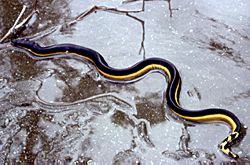 |
Yellow-bellied Sea Snake | Pelamis platurus | potentially fatal |

 Deep Sea Crabs
 Deep Sea Shrimps
 Deep Sea Lobsters