Deep Sea Otters
Common Name: Sea Otters
Scientific Name: Enhydra lutris
- What Is Sea Otter?
- What Do Sea Otter Eat?
- Where Do Sea Otter Live?
- How Do Sea Otter Reproduce?
- What Makes Them Unique?
- What Do They Look Like?
- What Is Their Status?
What Is Sea Otter?
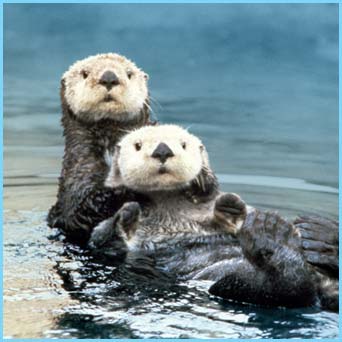
Sea otters are unusual among marine mammals in that they live outside of their zone of thermal neutrality and consequently have extremely high metabolic demands. As a result they require a high rate of food intake, up to 30% of their body weight per day, and they have limited capacity to cope with reduced food availability or additional physiological challenges. Moreover, a large proportion of their diet consists of filter-feeding benthic invertebrates, which tend to concentrate both contaminants and disease-causing pathogens that flow into near-shore waters from land. With their elevated metabolic rates, sea otters must consume large quantities of these invertebrates and thus they have high exposure rates to the associated parasites and pollutants. The net result of all these traits is that sea otters are especially susceptible to human-induced stressors in their environment, and like the proverbial "canary in a coal mine," they represent effective sentinels of the health of coastal oceans. Their utility as a sentinel (or indicator) of ecosystem health is further increased by their near-shore distribution, their extraordinary appeal to the general public (a fact that generates community support for monitoring efforts), and because they are relatively easy to observe.
What Do Sea Otter Eat?
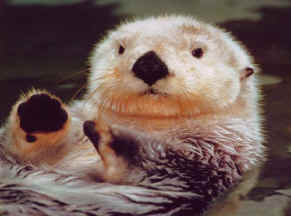
Sea Otters dive to the seafloor to obtain a variety of invertebrate animals. The most common prey of Sea Otters are sea urchins, mussels, abalone, clams, scallops, crabs, sea snails, chitons, octopus, and squid. An acute sense of touch, using paws, nose, and whiskers, is very important for finding prey in crevices or bottom sediments, and during dim light. Food items are normally clasped between tough leathery pads of the two forepaws and brought to the surface to eat. Several food items are often stored in a loose pocket of skin in the armpit area for transportation and while feeding. The ingenious Sea Otter uses rocks as tools to break open hard-shelled prey or to dislodge prey such as abalone. It is the only mammal other than the primates (monkeys, apes, humans) known to use tools. While eating, Sea Otters float on their backs, using their chest as a dinner table, and are often accompanied by gulls and small fish which scavenge on leftovers.
Where Do Sea Otter Live?
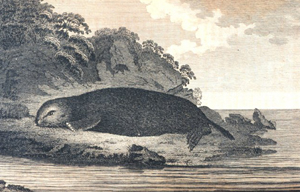
Sea Otters need unpolluted nearshore marine habitats, usually having depths under 40 m, an abundant food supply consisting primarily of shellfish, and freedom from excessive human disturbance. Complex coastlines having many islands, reefs, bays, and points provide a variety of feeding sites and shelter from storms, and appear to support the highest numbers of otters. Habitats of this nature occur along most of the outer coast of British Columbia. The reintroduced British Columbia population, possibly with the help of animals from northern Washington and southeast Alaska, may eventually expand their range into this vacant habitat. B.C.'s deep, steep-sided fjords may have little to offer Sea Otters in terms of food, and provide little protection from strong outflow winds. Georgia Strait may be unsuitable due to high summer water temperatures, particularly in its shallow nearshore waters, or because of pollution and human disturbance.
How Do Sea Otter Reproduce?
Females breed at four years old and have one pup every one to two years. Males mature at five or six years but may not breed until somewhat older. Although young may be born at any time of year, most births occur in spring or early summer. Most mating in northern waters is in the fall. The estimated gestation period is 6W to 9 months. Spring or early summer births may result in better survival than births at other seasons. Few births have been seen, but most are thought to occur in the water (unlike River Otters, seals and sea lions, which usually give birth on land). At birth the single pup weighs 1.4 to 2.3 kg and is well furred but relatively helpless. Pups receive a lot of maternal care and training until almost adult size, a period of six to eight months or more. Small pups suckle while lying on the female's chest; when larger they nurse while lying beside her in the water. Females with small pups tend to be solitary and to act aggressively toward other otters.
Females leave pups on the surface when they dive for food. They share solid food with the pups shortly after birth, but larger pups aggressively take food from their mothers. The young begin to dive in their second month; the duration of dives and success in finding food increases with age. There is much to learn during the period of dependency.
What Makes Them Unique?
In contrast to whales and seals, which rely on their blubber for insulation, the Sea Otter relies on its wellgroomed fur with many tiny air bubbles trapped in it. They have the thickest fur of any living animal, with an incredible 100 000 or more hairs per square centimetre. Frequent grooming activity prevents soiling of the fur, loss of insulation, and reduced buoyancy. The fur is rubbed meticulously with front and hind feet, the flexible otter rolling inside its baggy skin to reach the awkward parts. Folds of skin are squeezed between the forepaws or with the tongue to remove moisture. Finally the fur is aerated by blowing into it or churning the water to a froth with the paws.
To maintain body heat in chilly north Pacific waters, Sea Otters have a metabolic rate two or three times that of land mammals of similar size. This is made possible by a prodigious food intake (25 to 30 percent of body weight each day), an intestine 10 times the body length, and a rapid digestive rate. Air in the fur, together with large lungs (an adaptation for diving) cause Sea Otters to float high in the water. Other adaptations for diving include blood with a very high capacity to transport oxygen, and ear canals which can be closed. The Sea Otter has large, complex kidneys which allow it to drink seawater.
Sea Otters walk awkwardly on land and even in water do not have the speed or agility of seals. When lying face-up they move slowly by sculling the tail or paddling with one or both hindlimbs. Faster movements are always belly-down and involve up and down undulations of the entire body ("porpoising") with the hindfeet and tail held stiffly as an extension of the body, and the forefeet held against the chest. Normal speeds are 1 to 5 km an hour; the maximum about 9 km an hour. When at rest, Sea Otters lie on their backs, usually entwined in kelp to hold their position, feet held high in the air to prevent heat loss.
Most of a Sea Otter's day is spent feeding, grooming, or resting, usually in that order. Otters in Washington and British Columbia, where populations are small and food is abundant, may spend as little as 10 or 15 percent of their day feeding, compared to 50 or 60 percent at Amchitka Island, where otter numbers are high and readily available foods have been exhausted. Most daytime foraging activity occurs in the morning and late afternoon, most resting around midday.
The near extinction and subsequent increase of Sea Otters has allowed researchers to study their effects on benthic (seabottom) plant and animal communities as they recolonized or were transplanted into vacant habitats. Many areas that were otter-free for decades, particularly rocks and reefs, have dense populations of sea urchins and little or no kelp (large algae), this having been eaten by the grazing urchins. These areas are described as "sea urchin barrens". Research at Checleset Bay, Vancouver Island, and elsewhere has shown that introduced Sea Otters greatly reduce the urchin populations, allowing extensive stands of kelp to develop. These "kelp forests" drastically change the reef environment, provide habitat for fish such as perch, greenling, and lingcod, and moderate the effect of waves. Their foraging has thus had a profound influence on nearshore reef communities.
What Do They Look Like?
Two species of otters occur in British Columbia - the Sea Otter and the more widespread River Otter. River Otters frequent rivers and lakes, but are also common in saltwater along the entire British Columbia coast. An otter in the sea is usually not a Sea Otter!The Sea Otter (Enhydra lutris) is our smallest marine mammal, but is one of the largest of the world's 13 otter species - males weigh up to 45 kilograms and reach 148 centimetres in length. Females are slightly smaller. The tail is about one-third the length of head and body; the River Otter's is about twothirds. Sea Otters are frequently seen in large social groups, resting or feeding on their backs in offshore kelp beds.
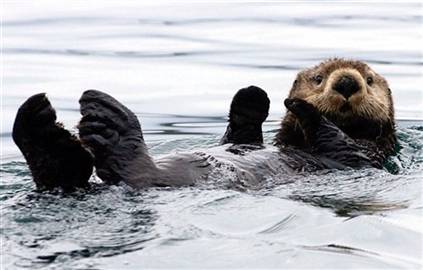
They rarely go ashore, but when they do, they choose remote offshore reefs or bars. River Otters seldom occur in groups larger than a single family (although families can include three or four young), don't rest on their backs, and come ashore frequently. Sea Otter fur, consisting of sparse guard hairs and dense, soft underfur, varies from dark brown to reddish brown. When dry, the fur on the head is cinnamon to light brown. The body is entirely furred except for the tip of the nose, inside of the ears, and palms of the stubby mitten-like forefeet. The flipperlike hindfeet have short, sparse fur. Prominent whiskers, and the grizzled facial fur of older animals have given rise to the nickname "old man of the sea."
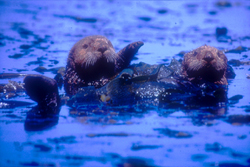
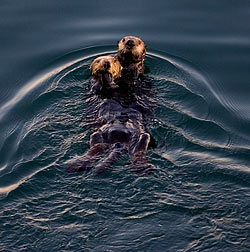
Groups of the sociable Sea Otter are called rafts, and usually consist entirely of females and pups or of males. Male rafts are usually larger (up to 100 or more in Alaska); but female rafts may contain up to 40 adults with their pups. Most individuals make short daily movements between favourite feeding sites and more protected resting areas, resulting in seasonal home ranges of 5 to 10 square kilometres in size. However, studies in Alaska and California have shown that many adult males make yearly or more frequent trips of 80 to 145 km from male rafts to establish temporary breeding territories in female areas.
What Is Their Status?
Following reintroduction, the Sea Otter population in Canada has increased to about 900 animals and has been growing at a rate of 17 to 20 percent per year. The Sea Otter has been assigned Endangered status by the Committee on the Status of Endangered Wildlife in Canada (COSEWIC), and receives legal protection as a marine mammal under the Canada Fisheries Act. It has been placed on British Columbia's Red List and has been legally designated as an Endangered Species under the Wildlife Act. Throughout their range in the U.S., Sea Otters receive protection under the Marine Mammals Protection Act. The California population, a separate subspecies (variety) named the "Southern Sea Otter," is afforded additional Federal protection as a Threatened Species under the U.S. Endangered Species Act.
Why Are Sea Otters At Risk?
Prior to decimation by the fur trade, Sea Otters were found in a great arc around the North Pacific: from northern Japan via the coastlines of the Kuril Islands, Kamchatka, Commander and Aleutian Islands, Gulf of Alaska, British Columbia, Washington, Oregon and California, south to the vicinity of Cedros Island, Mexico. Native people harvested Sea Otters throughout their range, but this was unlikely to have seriously reduced any populations. However, a 150-year period of ruthless exploitation began with Vitus Bering's exploration of the Aleutians and Gulf of Alaska in 1741. The journals of such explorers, and the luxuriant pelts they brought back, revealed to the world the commercial potential of this far-flung resource. The ensuing maritime fur trade, with China and Europe the major markets, resulted in fierce competition between Russian, American, British, and Spanish traders, and sparked numerous territorial disputes. One of these, the " Nootka Controversy ", brought threats of war between Britain and Spain. Prior to exploitation, the worldwide population of Sea Otters was estimated at between 150 000 and 300 000. During 126 years of Russian control, more than 800 000 are believed to have been taken in Alaska alone. Hundreds of thousands were also obtained along the Alaska to California coastline. By 1911, when a treaty to protect fur seals and Sea Otters was signed by Japan, Russia, Britain (for Canada) and the United States, between 1000 and 2000 Sea Otters remained in a dozen scattered locations from the Kuril Islands, Russia, to Prince William Sound, Alaska, and at one site near Carmel, California. The last Canadian record was a specimen obtained near Kyuquot on Vancouver Island in 1929.
Following protection, the remnant Sea Otter populations increased gradually. An estimated 150 000 or more now occupy most of their original range from the Kuril Islands to Prince William Sound, and the isolated remnant in California has increased to about 2000.
Like most marine mammals, Sea Otters have low reproductive rates. However, many new populations in formerly vacant habitats have increased steadily at rates as high as 17 to 20 percent per year, indicating that in areas where populations have not reached the limits of their habitat, natural mortality levels must also be quite low. In areas where populations have reached maximum densities, such as Amchitka Island in Alaska, starvation is probably the most common cause of death. Mortality also occurs due to excessively worn teeth, which may be accompanied by disease, parasitism, or infection. Severe, prolonged storms can also cause death of pups, aged, or weak individuals. At Amchitka Island, nesting Bald Eagles regularly prey on Sea Otter pups left untended on the ocean surface. This may also happen in other areas. There are reports of predation by Killer Whales, sharks and sea lions.
Human-caused mortality, though much reduced since the early 1900s, is still a cause for concern. The Exxon Valdez oil spill in Prince William Sound, Alaska, in 1989 wiped out nearly half of the Sea Otters in the oiled area of the Sound; the much smaller Nestucca spill off Washington in 1988 killed at least one otter at Checleset Bay, 440 kilometres north of the spill site. Small amounts of oil, by affecting insulation, can cause hypothermia for Sea Otters, and any major spill, an ongoing threat on the B.C. coast, could be catastrophic. Entanglement in fishing nets may cause significant losses in some parts of their range. Shooting, harassment and general disturbance by boat traffic are of common concern in California where large numbers of people live in close proximity to these animals.
What Can We Do?
Sea Otters were reintroduced to Canadian waters between 1969 and 1972. This was a cooperative effort involving BC Environment (Fish and Wildlife Branch), Fisheries and Oceans Canada (Pacific Biological Station), Canadian Armed Forces (Search and Rescue, Comox), U.S. Bureau of Sport Fisheries and Wildlife, Alaska Fish and Game Department, and U.S. Atomic Energy Commission. There were three releases totalling 89 Sea Otters (taken from Amchitka Island and Prince William Sound) at the Bunsby Islands in Checleset Bay, on Vancouver Island, during this time. This nucleus has grown to over 900, distributed from Nootka Sound to Quatsino Sound, and is increasing.
An Ecological Reserve covering all of Checleset Bay (the Sea Otter release site) was established by BC Parks in 1981, and harvest closures on many key shellfish eaten by the otters (clams, sea urchins, abalone) have been instituted in the reserve by the Department of Fisheries and Oceans Canada (DFO). Periodic aerial surveys are undertaken by BC Environment, BC Parks, and DFO.
Two status reports have been prepared and recovery and management plans are in preparation. BC Parks controls activities in Checleset Bay by issuing research, educational, and other permits. Research has been undertaken there on effects of Sea Otters on marine communities.
Once extinct on our coast, Sea Otters are now expanding to reoccupy their former habitats and to resume their role in the ecology of B.C.'s coastal ecosystems. Expansion to new areas will also provide increased opportunities for the public to view this engaging animal in the wild. The outlook for B.C.'s Sea Otter is good, although present populations are still relatively small and vulnerable. The public is urged to support programs aimed at preserving this valuable member of our coastal fauna.

 Deep Sea Crabs
 Deep Sea Shrimps
 Deep Sea Lobsters