Deep Sea Calendar - May
By Month - Jan | Feb | Mar | april | June | Aug | Sep | Oct | Nov | Dec
Dense fog is common during May and June in Channel Islands National Marine Sanctuary.
Gray whales (Eschrichtius robustus) migrate north through Channel Islands National Marine Sanctuary from calving grounds in Baja California, Mexico to Alaskan feeding grounds (Mid-February through May).
Blue whales (Balaenoptera musculus), fin whales (Balaenoptera physalus), and sei whales (Balaenoptera borealis) arrive in the Channel Islands National Marine to feed on krill from the nutrient rich, upwelled water (late-May through September).
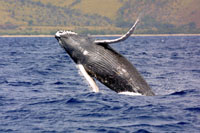
Humpback Whales (Megaptera Novaengliae)Humpback Whales (Megaptera novaengliae) feed in rich, upwelled waters of Channel Islands National Marine Sanctuary (May through August).
Pacific harbor seal (Phoca vitulina) pupping season on San Miguel Island (February through May).
Brant geese (Branta bernicla) stop to rest and feed in the Channel Islands region on their annual migration between Mexico and Alaska (March through May).
Nearly on quarter-million seabirds nesting on the nearby Farallon Islands forage in the Gulf of the Farallones and Cordell Bank National Marine Sanctuaries, March through mid-August.
During early spring, island wildflowers such as the Giant Coreopsis (Coreopsis gigantea) are in full bloom (March through early April) on the Channel Islands Sanctuary.
Gray whales (Eschrichtius robustus) migrate north through Channel Islands, Monterey Bay, Gulf of the Farallones and Cordell Bank National Marine Sanctuaries from calving grounds in Baja California, Mexico to Alaskan feeding grounds (Mid-February through May).
Peak egg-laying season for California Brown Pelicans (Pelecanus occidentalis californicus) on Anacapa and Santa Barbara Islands (March and April).
Endangered Least Terns (Sterna antillarum browni) can be seen in the Channel Islands Region (May through August).
Pink-Footed Shearwaters (Puffinus creatopus) and Sooty Shearwaters (Puffinus griseus) visit the Santa Barbara Channel from the southern hemisphere (May through October).
Ashy Storm-Petrels (Oceanodroma homochroa) and Black Storm-Petrels (Oceanodroma melania) visit the Santa Barbara Channel (mid-May to mid-October).
Red-Necked Phalaropes (Phalaropus Lobatus)Red-Necked Phalaropes (Phalaropus lobatus) can be seen in the Santa Barbara Channel in the spring (April and May) and fall (August through October).

 Deep Sea Crabs
 Deep Sea Shrimps
 Deep Sea Lobsters