Okeanos Explorer: A New Paradigm for Exploration
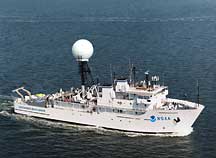
Okeanos Explorer will be operated by the NOAA Marine and Aviation Operations commissioned officers of the NOAA Corps and civilians in support of the NOAA Office of Ocean Exploration. The Corps is composed of officers-all scientists and engineers-who provide operational, management and technical skills supporting NOAA's environmental programs.
Though far from Okeanos Explorer, scientists ashore will be full members of the science team, operating in science command centers, exchanging data and analyzing real-time, deep-ocean images taken by remotely operated vehicles on the ocean floor. High-speed satellite to Internet pathways will also offer exciting educational opportunities to raise ocean literacy.
NOAA, an agency of the U.S. Department of Commerce, is dedicated to enhancing economic security and national safety through the prediction and research of weather and climate-related events and providing environmental stewardship of the nation's coastal and marine resources.
"Okeanos Explorer will break the mold for the way the nation conducts at-sea research in the future. We have better maps of Mars and the far side of the moon than of the deep and remote regions of Earth," said retired Navy Vice Admiral Conrad C. Lautenbacher Jr., Ph.D., undersecretary of commerce for oceans and atmosphere and NOAA administrator. "Senator Reed and Governor Carcieri have been outspoken champions of the oceans. Their support combined with the wealth of academic and oceanographic institutions in New England would lead to many exciting collaborations in ocean exploration."
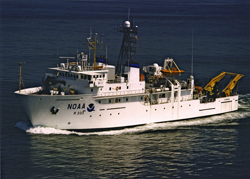
As part of the NOAA fleet, Okeanos Explorer will be operated, managed and maintained by the NOAA Office of Marine and Aviation Operations. Its crew will consist of technical specialists, wage mariners, scientists, and commissioned officers of the NOAA Corps-the nation's seventh uniformed service. The Corps is composed of scientists and engineers who provide NOAA with an important blend of operational, management and technical skills that support the agency's environmental programs at sea, in the air and ashore. A NOAA Corps officer will command Okeanos Explorer.
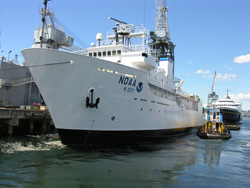
Since 2004, the NOAA Ocean Exploration (OE) program and Dr. Robert Ballard's Institute for Exploration (IFE) have conducted a series of expeditions using IFE's ROV's Hercules and Argus, and telepresence technology to provide scientists working on shore high-definition video, images, and data in real time. These expeditions have also provided an opportunity for students, teachers, and the general public to share in the excitement of discovery through events staged at "Expedition Command Centers," through links to real-time video via the Internet, and to various informal science centers and the Boys and Girls Clubs of America through a partnership with Immersion Presents. Finally, each expedition has served as a proving ground for a new paradigm for exploring unknown and poorly known ocean areas and phenomena using the new NOAA Ship Okeanos Explorer, currently undergoing conversion in Seattle, WA.
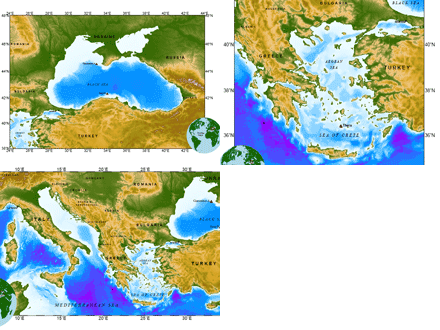
During the month of August, OE and IFE will engage in two efforts that will be invaluable for finalizing our plans for the inaugural year of the Okeanos Explorer. First, we will be revisiting the Aegean and Black Seas to further explore the natural environment and to search for and investigate Byzantine shipwrecks. This time, the expedition includes specific objectives for testing and evaluating systems and protocols similar to those being installed on the new ship. Second, the Okeanos Explorer will undergo sea trials to test all of the systems installed on the vessel during the first phase of the conversion, including equipment for operating and navigating the vessel, as well as equipment designed to meet mission objectives. The results of the sea trials will be critical for guiding the second phase of the conversion, which will include the installation of the high-end technology to support telepresence, and the integration of the equipment to operate a new two-vehicle ROV system similar to the Hercules and Argus.
This "mission" is unique in that it will focus on two field activities involving the dedicated team of OE and IFE staff who are working to ensure that the Okeanos Explorer will help NOAA and the Nation usher in a new era of ocean exploration.

 Deep Sea Crabs
 Deep Sea Shrimps
 Deep Sea Lobsters