Pelagic Cormorant
Common Name: Pelagic Cormorant
Scientific Name: Phalacrocorax pelagicus
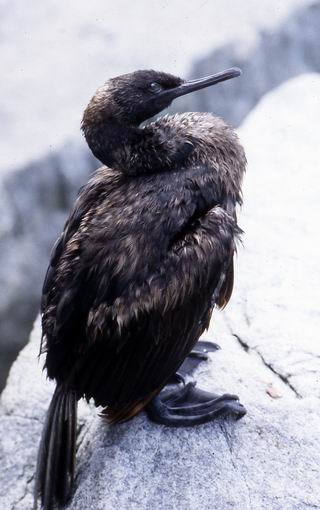
Description
The Pelagic Cormorant and the Red-faced Cormorant are two of the three species of cormorants that nest in Alaska. They differ from the third cormorant species, the Double-crested Cormorant, in that they are strictly marine birds. Cormorants are part of a large family of seabirds that includes pelicans, boobies, tropicbirds, and frigatebirds. They are diving birds that use their large webbed feet to swim underwater in search of food. They like to eat a wide variety of foods but their favorite is fish that live close to the ocean floor. Their feathers are different from other diving birds in that they are not naturally waterproof. In order to waterproof their feathers, cormorants must spend a lot of time preening or grooming their feathers with oil they collect on their bills from a gland at the base of their tail.
Unlike many other seabirds, cormorants do not like to stray far from their nesting colonies on land. There they build large nests out of whatever plant material they can find and are not above stealing it from one of their unsuspecting neighbors. Often one bird of the pair will present a piece of grass or seaweed to its mate as a way of strengthening their bond.
Pelagic Cormorants nest on coastal headlands or islands throughout Alaska and the Asian North Pacific. Red-faced Cormorants nest in a much smaller region of the North Pacific that stretches from northern Japan through the Aleutian Islands. Both species use their own excrement to cement their nests onto small ledges of vertical cliff faces.
Pelagic and Red faced Cormorants are not only similar in habits, but also in their appearance. During the winter they look nearly identical except the Red-faced Cormorant is slightly larger. However, in the spring the birds begin to dress-up for the breeding season and the two species can be more easily separated by their appearance. Pelagic Cormorants develop a patch of dark red skin around their eyes and base of the bill. They often develop long white plumes on their necks. Red-faced cormorants develop a patch of reddish-orange skin around their eyes that extends up onto their foreheads and the base of their bill turns light blue. Both species have two crests on their heads but these are much more obvious on Red-faced Cormorants.
Diet
- Fish and crustaceans
Habitat
- Ledges of cliffs, ground on islands. Nests made of seaweed and guano.
Identification Tips
- Length: 22 inches Wingspan: 40 inches
- Sexes similar
- Large, dark waterbird with a long, hooked bill and long tail
- Long, thin neck
- Gular region red
- Often perches with wings spread to dry them
Adult
- Entirely dark plumage except for white flank patch
- Two crests on head
- Thin, white plumes on neck
Immature
- Very dark plumage
Similar Species
Loons are similar on the water, but lack hooked bills. Most loons hold their bills level while swimming while cormorants hold theirs angled upwards. All adult cormorant species in the U.S. are separable by the shape and color of the gular areas. No other species has a small red gular region. The Pelagic Cormorant shares its Pacific Coast range with the Double-crested and Brandt's Cormorants. Adult Double-crested Cormorants have orange gular regions and Brandt's have yellow-bordered blue ones. Immature Double-cresteds and Brandt's have paler underparts than the Pelagics. The Pelagic Cormorant is noticeably smaller and slimmer than the other species. The Red-faced Cormorant overlaps the range of the Pelagic Cormorant only in Alaska. In the breeding season, the Red-faced Cormorant has a red forehead and a pale bill.

 Deep Sea Crabs
 Deep Sea Shrimps
 Deep Sea Lobsters