Northern Wildfire Smoke May Cast Shadow on Arctic Warming - July 21, 2008
The Arctic may get some temporary relief from global warming if the annual North American wildfire season intensifies, according to a new study by researchers at the University of Colorado and NOAA.
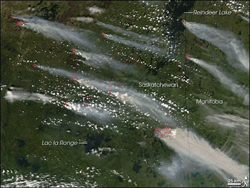
Smoke transported to the Arctic from northern forest fires may cool the surface for several weeks to months at a time, according to the most detailed analysis yet of how smoke influences the Arctic climate relative to the amount of snow and ice cover.
"Smoke in the atmosphere temporarily reduces the amount of solar radiation reaching the surface. This transitory effect could partly offset some of the warming caused by the buildup of greenhouse gases and other pollutants," said Robert Stone, an atmospheric scientist with the university and NOAA Cooperative Institute for Research in Environmental Sciences (CIRES) and lead author of the study, which appears this week in the Journal of Geophysical Research.
How much solar energy is prevented from reaching the surface depends on the smoke's opacity, the elevation of the sun above the horizon, and the brightness of the surface, according to the study.
Stone and his research colleagues analyzed the short-term climate impact of numerous wildfires that swept through Alaska and western Canada in 2004. That summer, fires burned a record 10,000 square miles of Alaska's interior and another 12,000 square miles in western Canada.
A NOAA climate observatory near Barrow, Alaska, provided the data for the study. Smoke observed at Barrow was so thick that at times visibility dropped to just over one mile. The aerosol optical depth (AOD), a measure of the total absorption and scattering of solar radiation by smoke particles, rose a hundredfold from typical summer values.
Smoke in the atmosphere tends to cool the snow-free tundra while warming the smoke layer itself, the authors found. Smoke has an even greater cooling effect over the darker, ice-free ocean and less over bright snow.
"The heating of the smoke layer and cooling of the surface can lead to increased atmospheric stability, which in turn may keep clouds from forming," said Stone. "We think that this influence of smoke aerosol on clouds further affects the balance of radiation reaching the surface in the Arctic."
Research observatories as far away as Greenland and the Svalbard archipelago north of Norway also recorded elevated AOD values over several weeks during the 2004 summer, suggesting that the climate footprint of the North American wildfires was far-reaching. Smoke from the same fires also was observed as far south as the Gulf of Mexico.
To conduct their analysis, Stone and colleagues looked at how a range of smoky conditions might change the amount of solar radiation reaching the Earth's surface. Models showed that the cooling caused by future forest fires would depend on the severity of the fire season and on the geographic dispersion of smoke.
The authors cautioned, however, that the full climate impact of Arctic aerosols, including smoke particles, is still not entirely clear. For one thing, smoke particles captured within clouds or deposited on snow may change the brightness of these objects, further affecting the amount of solar radiation absorbed by the surface.
Also, aerosols such as smoke affect the absorption and scattering not only of solar radiation, but also of longwave or thermal radiation within the atmosphere. The impact of aerosols on longwave radiation, which dominates at night and during the long, dark winter season in the Arctic, has yet to be quantified.
NOAA understands and predicts changes in the Earth's environment, from the depths of the ocean to the surface of the sun, and conserves and manages our coastal and marine resources.

 Deep Sea Crabs
 Deep Sea Shrimps
 Deep Sea Lobsters