Deep Sea Mollusks
Molluscs are animals belonging to the phylum Mollusca. There are around 93,000 documented extant group within this phylum.Molluscs are a highly diverse group, in size, in anatomical structure, in behaviour and in habitat. Representatives of the phylum live in a wide range of environments including marine, freshwater, and terrestrial biotopes.
The phylum Mollusca is characteristically divided into nine or ten taxonomic classes, of which two are completely extinct. Cephalopod molluscs such as squid, cuttlefish and octopus are among the most neurologically-advanced of all invertebrates – and either the giant squid or the colossal squid is the largest known invertebrate species. The gastropods (snails and slugs) are by far the most numerous molluscs in terms of classified species, and account for 80% of the total.
Abalone
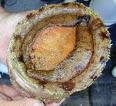
Abalone is medium-sized to very large edible sea snails, marine gastropod mollusks in the family Haliotidae and the genus Haliotis.Common names for abalones also include ear-shells, sea-ears and Venus's-ears, as well as muttonfish or muttonshells in Australia, ormer in Jersey and Guernsey, perlemoen in South Africa and paua in New Zealand.
The shells of abalones have a low and open spiral structure, and are characterized by several respiratory holes in a row near the shell's outer edge. The thick inner layer of the shell is composed of nacre or mother-of-pearl, which in many species is highly glistening, giving rise to a choice of strong and changeable colors, which make the shells gorgeous to humans as attractive objects, and as a source of colorful mother-of-pearl.
Cockle
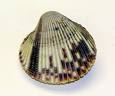
The individual rounded shells of cockles are symmetrical, and are heart-shaped when viewed from the end. In most but not all genera there are numerous radial ribs. For an exception, see the genus Laevicardium, the egg cockles, which have very smooth shells. Empty cockle shell on the beach. The wrapper has three apertures (inhalant, exhalant, and pedal) for siphoning water and for the foot to bulge. Cockles classically tunnel using the foot, and feed by filtering plankton from the neighboring water. Cockles are accomplished of 'jumping' by circuitous and straightening the foot. Like many bivalves, cockles are hermaphroditic and some species reach maturity quickly.
Conch
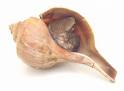
A conch is one of a number of special type of medium-sized to great saltwater snails or their shells. True conchs are marine gastropod mollusks in the family Strombidae, and the genus Strombus.The name "conch" however, is often quite loosely applied in English-speaking countries to numerous kinds of very large sea snail shells which are pointed at both ends, i.e. shells which have a high spire and a noticeable siphonal passage. Other species often called a "conch" include the coronet conch Melongena order; the horse conch Pleuroploca gigantea; and the sacred chank or more correctly Shankha shell, Turbinella pyrum. None of these are in the family Strombidae, they are all in other taxonomic families.
The true conch species within the species Strombus vary in size from fairly small to very large. Quite a lot of of the larger species such as Strombus gigas, the crimson conch or queen conch, are reasonably important as food sources. Strombus gigas is also accomplished of producing (very rarely) a pink, gem quality pearl.
Mussel
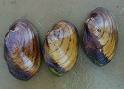
The universal name mussel is used for members of numerous different families of clams or bivalve molluscs, from both saltwater and freshwater habitats. The one thing that these different groups have in common, is that they have a shell whose outline is somewhat elongated and unbalanced compared with that of many other edible clams, the shells of which are often more or less curved or oval in shape.
The word "mussel" is most recurrently used to mean the cooked bivalves of the nautical family Mytilidae, most of which live on showing shores in the intertidal zone, emotionally concerned by means of their strapping byssal threads ("beard") to a compacted substrate. A few genus (in the genus Bathymodiolus) have settled hydrothermal
vents associated with deep ocean ridges.
In most nautical mussels the shell is longer than it is wide, being wedge-shaped or lop-sided. The tangential color of the covering is often dark blue, blackish, or brown, while the interior is silvery and rather nacreous.Octopuses
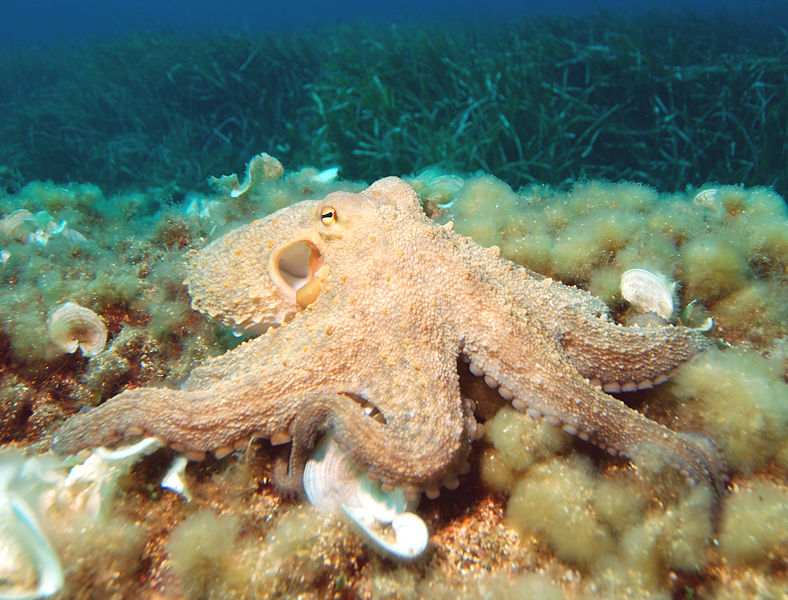
Octopuses are characterized by their eight arms. Frequently bearing suction cups. Octopuses have a comparatively short life expectancy, and some species live for as little as six months. Larger species, such as the North Pacific Giant Octopus, may live for up to five years under suitable circumstances. However, reproduction is a cause of death: males can only live for a few months after mating, and females die shortly after their eggs hatch. They neglect to eat during the (roughly) one month period spent taking care of their unhatched eggs, but they don't die of starvation. Endocrine secretions from the two optic glands are the cause of genetically-programmed death (and if these glands are surgically removed, the octopus may live many months beyond reproduction, until she finally starves).
Octopuses are extremely intelligent, probably more intelligent than any other order of invertebrates. The exact extent of their cleverness and learning capability is much debated among biologists, but maze and problem-solving experiments have shown that they do have both short- and long-term memory. Their short lifespan limit the amount they can eventually learn. There has been much speculation to the effect that almost all octopus behaviors are autonomously learned rather than instinct-based, although this remains largely unproven. They learn almost no behaviors from their parents, with whom young octopuses have very little contact.
Oyster
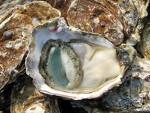
The common name oyster is used for a number of different groups of bivalve mollusks, most of which live in marine habitats or brackish water. The shield consists of two habitually extremely calcified valves which surround a soft body. Gills strain plankton from the water, and strong adductor muscles are worn to hold the shell closed. Some types of oysters are very much prized as food, both raw and cooked. Other types, such as pearl oysters, are not commonly eaten.
True oysters, belonging to the family Ostreidae, are incapable of making gem-quality pearls, although the opposite idea is a commonly-encountered misapprehension, often seen in illustrations or photographs where an edible oyster shell is mistakenly paired with a gem-quality pearl.
Although Jonathan Swift is repeatedly quoted as having said, "He was a bold man that first ate an oyster", evidence of oyster spending goes back into prehistory, as evidenced by oyster middens originate worldwide. Oysters were an vital food source in all coastal areas where they could be found, and oyster fisheries were an important industry where they were abundant. Overfishing and heaviness from diseases and pollution have sharply reduced supplies, but they remain a popular pleasure, renowned in oyster festivals in many cities and towns.Oysters are a desired among striking foods and research now shows this shellfish to be a rich source of zinc, one of the natural resources required for the fabrication of testosterone.
Snails
Snails have been eaten for thousands of years, opening in the Pleistocene. They are particularly plentiful in Capsian sites in North Africa but are also found right through the Mediterranean province in archaeological sites dating between 12,000 and 6,000 years ago. However, it should be noted that wild-caught land snails that are undercooked can harbor a parasite (Angiostrongylus cantonensis) that may cause a rare kind of meningitis. Dedicated snail caviar is also growing in popularity in European cuisine.
Genus of land snails live in roughly every kind of habitat, from deserts and mountains to marshes, woodland, and gardens. However, confident species are "anthropophilic", which means they are originating most often around human habitation.
Whichever practically bulky land snail species is most usually seen or most usually eaten in a specified area, that species will habitually be referred to simply as "snails" by the local people. In many parts of the world, the reasonably large cooked species Helix aspersa or Cornu aspersum, has been introduced, and has become a pest in farms and gardens, so this is perhaps a good example of a species commonly known as "the snail".
Squid
Many species of squid are well-liked as food in cuisines as various as Japanese and Italian.In English-speaking countries, squid as food is often known by the Italian word calamari.Individual species of squid are found plentifully in certain areas, and supply large catches for fisheries.The body of squid can be stuffed whole, cut into flat pieces or sliced into rings. The arms, tentacles and ink are also fit to be eaten; in fact, the only parts of the squid that are not eaten are its bill and gladius (pen).
Squid are members of the class Cephalopoda, subclass Coleoidea, order Teuthida, of which there are two major suborders, Myopsina and Oegopsina (counting the giant squids like Architeuthis dux). Teuthida is the largest of the cephalopod orders, edging out the octopuses (order Octopoda) for total number of species, with roughly 300 confidential into 29 families.

 Deep Sea Crabs
 Deep Sea Shrimps
 Deep Sea Lobsters