Steller Sea Lion
Common Name: Steller Sea Lion
Scientific Name: Eumetopias jubatus
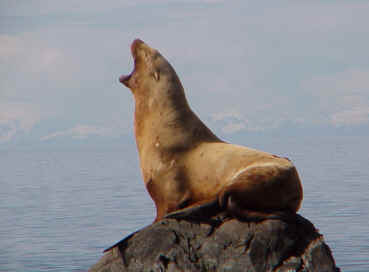
Description
Steller's sea lion, or northern sea lion, is the largest member of the family of eared seals - Otariidae. A bull Steller's sea lion weighs an average of 1,300 pounds and measures approximately eleven feet long, and a female averages at 600 pounds and nine feet. They were described and named by German naturalist Georg Wilhelm Steller who sailed with Vitus Bering on his voyages to the Bering Sea and North American coast of the Pacific. Steller's sea lions range from the northern islands of the Japanese archipelago north to the Bering Straits, and south along the coast to northern California. Steller's sea lions are voracious predators, feeding on pollock, flounder, herring, capelin, Pacific cod, salmon, rockfish, sculpins, squid and octopus. They are prey only to killer whales, large sharks, and humans. Early people of the north Pacific coast depended heavily on them for food, clothing, and boat coverings. The estimated populations of Steller's off Alaska declined from 242,000 animals in the early 1970s to less than half of that now. Their dramatic decline is the subject of intense study and is probably the result of many factors including disease, environmental change, natural predation on juveniles, and the activities of commercial fishing fleets. Steller's sea lions are listed as a threatened species under the Endangered Species Act.
Their center of abundance has been in the Aleutian Islands and Gulf of Alaska where historically nearly three-fourths of all Steller sea lions inhabiting U.S. territory were found. Two populations are currently recognized. The western population, located from Prince William Sound Alaska westward, has declined by about 85% since the 1970s for reasons that are poorly understood.
However, they appear to be related to at least in part to prey availability. The eastern population, located east of Prince William Sound appears to be recovering slowly. Steller sea lions haulout on land to mate, bear their young, nurse, avoid predators, and rest. The location of rookeries is probably based on proximity to food sources, protection from terrestrial and marine predators, topography, surf conditions, and other factors.
Steller sea lions are generally considered nonmigratory although some individuals, particularly juveniles and adult males, may disperse widely outside the summer breeding season. Most adult sea lions return to their birth site for reproduction.
Range and Habitat
Found along the rim of the North Pacific Ocean.
Life
20-30 years.
Physical Characteristics
| At Birth | At Maturity | |
| Length | Unknown | 2.3 - 2.8m |
| Weight | 16.23 kg(31-50 lb) | 263 - 566 kg(770-1250 lb |

 Deep Sea Crabs
 Deep Sea Shrimps
 Deep Sea Lobsters