Common Murre
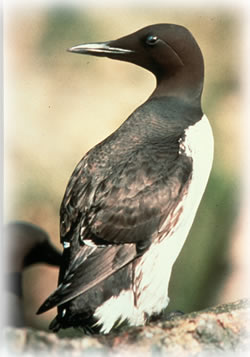
Common Name: Common Murre
Scientific Name: Uria aalge
Description
The common murre is one of the success stories of the sea - about 10 million breed in the northern parts of the Pacific and Atlantic Oceans, and millions more are young birds that are gaining the experience they'll need to attempt nesting the first time. Many of the features of murres' life history show just how difficult life at sea is. Murres don't even try to breed for the first time until they're five or six years old and murres lay only one egg in a clutch, probably because the difficulty of finding food means that they are able to feed only one chick. Both parents take turns incubating the egg on a bare rock ledge.
Behaviour
Common murres can fly 200 kilometers from the nest to find food for their chicks, and may dive as deep as 100 meters for food, but 70 kilometers and 50 meters are probably more typical maximums.
Diet
Murres feed their chicks three to five fish a day, and adults eat mostly fish too, but they may also consume zooplankton and squid.
Identification Tips
- Length: 14 inches
- Sexes similar
- Immature like basic-plumaged adult but often with smaller bill
- Large alcid that dives for food from water surface
- Thin, pointed bill
- Small, rounded tail
- Blurry streaks make flanks appear dusky
- Thin white trailing edge to secondaries visible at rest
- Pelagic bird only coming ashore to breed
Similar Species
The Thick-billed Murre is very similar to the Common Murre. In breeding plumage the Thick-billed Murre is blacker above with a white point intruding into the black throat. In winter, the Thick-billed Murre has a darker face without the dark line on the cheek. At close range in all plumages, it has a thin, white line on the bill that the Common Murre lacks and an overall heavier bill. Razorbills have heavier bills, whiter flanks, and pointed tails. Guillemots also have thin bills but are all black with white wing patches in summer and are much paler in winter with white wing patches.

 Deep Sea Crabs
 Deep Sea Shrimps
 Deep Sea Lobsters