Loggerhead Sea Turtle
Description
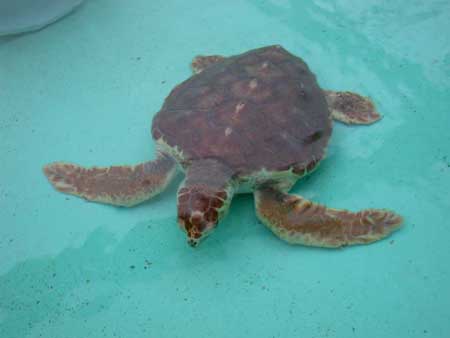
Loggerheads were named for their relatively large heads, which support powerful jaws and enable them to feed on hard-shelled prey, such as whelks and conch. The carapace (top shell) is slightly heart-shaped and reddish-brown in adults and sub-adults, while the plastron (bottom shell) is generally a pale yellowish color. The neck and flippers are usually dull brown to reddish brown on top and medium to pale yellow on the sides and bottom. Mean straight carapace length of adults in the southeastern U.S. is approximately 36 in (92 cm); corresponding weight is about 250 lbs (113 kg).
Loggerheads reach sexual maturity at around 35 years of age. In the southeastern U.S., mating occurs in late March to early June and females lay eggs between late April and early September. Females lay three to five nests, and sometimes more, during a single nesting season. The eggs incubate approximately two months before hatching sometime between late June and mid-November.
Hatchlings vary from light to dark brown to dark gray dorsally and lack the reddish-brown coloration of adults and juveniles. Flippers are dark gray to brown above with white to white-gray margins. The coloration of the plastron is generally yellowish to tan. At emergence, hatchlings average 1.8 in (45 mm) in length and weigh approximately 0.04 lbs (20 g).
Habitat
Loggerheads occupy three different ecosystems during their lives--the terrestrial zone, the oceanic zone, and the "neritic" zone. Loggerheads nest on ocean beaches, generally preferring high energy, relatively narrow, steeply sloped, coarse-grained beaches. Immediately after hatchlings emerge from the nest, they begin a period of frenzied activity. During this active period, hatchlings move from their nest to the surf, swim and are swept through the surf zone, and continue swimming away from land for about one to several days.
After this swim frenzy period, post-hatchling loggerheads take up residence in areas where surface waters converge to form local downwellings. These areas are often characterized by accumulations of floating material, such as seaweed (e.g., Sargassum), and, in the southeast U.S., are common between the Gulf Stream and the southeast U.S. coast, and between the Loop Current and the Gulf Coast of Florida. Post-hatchlings within this habitat are observed to be low-energy float-and-wait foragers that feed on a wide variety of floating items (Witherington 2002). As post-hatchlings, loggerheads may linger for months in waters just off the nesting beach or become transported by ocean currents within the Gulf of Mexico and North Atlantic. Work by Lohmann and Lohmann (1994b, 1996) and Lohmann et al. (1999) suggests that loggerheads may continue some oriented swimming in order to keep from being swept into cold North Atlantic currents.
Once individuals get transported by ocean currents farther offshore, they've entered the oceanic zone. Within the North Atlantic, juvenile loggerheads have been primarily studied in the waters around the Azores and Madeira (Bolten 2003). Other populations exist (e.g., in the region of the Grand Banks off Newfoundland), but data on these populations are limited. The juvenile turtles around the Azores and Madeira spend the majority of their time in the top 15 feet (5 m) of the water column.
Somewhere between the ages of 7 to 12 years, oceanic juveniles migrate to nearshore coastal areas (neritic zone) and continue maturing until adulthood. In addition to providing critically important habitat for juveniles, the neritic zone also provides crucial foraging habitat, inter-nesting habitat, and migratory habitat for adult loggerheads in the western North Atlantic. To a large extent, these habitats overlap with the juvenile stage, the exception being most of the bays, sounds, and estuaries along the Atlantic and Gulf coasts of the U.S. from Massachusetts to Texas, which are infrequently used by adults. However, adult loggerheads are present year-round in Florida Bay, an important feeding area, probably because of relatively easy access to open ocean and migratory routes. The predominate foraging areas for western North Atlantic adult loggerheads are found throughout the relatively shallow continental shelf waters of the U.S., Bahamas, Cuba, and the Yucatn Peninsula, Mexico. Migration routes from foraging habitats to nesting beaches (and vice versa) for a portion of the population are restricted to the continental shelf, while other routes involve crossing oceanic waters to and from the Bahamas, Cuba, and the Yucatn Peninsula. Seasonal migrations of adult loggerheads along the mid- and southeast U.S. coasts have also been documented.
Reproduction and Development
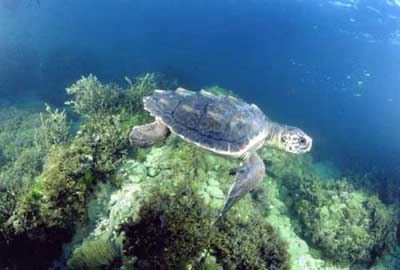
The United States nesting season extends from about May through August with nesting occurring primarily at night. Loggerheads are known to nest from one to seven times within a nesting season (mean is about 4.1 nests per season) at intervals of approximately 14 days. Mean clutch size varies from about 100 to 126 along the southeastern United States coast. Incubation ranges from about 45 to 95 days, depending on incubation temperatures, but averages 55 to 60 days for most clutches in Florida. Hatchlings generally emerge at night. Remigration intervals of 2 to 3 years are most common in nesting loggerheads, but remigration can vary from 1 to 7 years. Age at sexual maturity is believed to be about 20 to 30 years.
The loggerhead sea turtle occurs throughout the temperate and tropical regions of the Atlantic, Pacific, and Indian Oceans. However, the majority of loggerhead nesting is at the western rims of the Atlantic and Indian oceans. The most recent reviews show that only two loggerhead nesting beaches have greater than 10,000 females nesting per year: South Florida (U.S.) and Masirah (Oman). Those beaches with 1,000 to 9,999 females nesting each year are North Florida through North Carolina (U.S.), Cape Verde Islands (Cape Verde, eastern Atlantic off Africa), and Western Australia (Australia). Smaller nesting aggregations with 100 to 999 nesting females annually occur in Northwest Florida (U.S.), Cay Sal Bank (Bahamas), Quintana Roo and Yucatn (Mexico), Sergipe and Northern Bahia (Brazil), Southern Bahia to Rio de Janerio (Brazil), Tongaland (South Africa), Mozambique, Arabian Sea Coast (Oman), Halaniyat Islands (Oman), Cyprus, Peloponnesus (Greece), Island of Zakynthos (Greece), Turkey, and Queensland (Australia). Although the major nesting concentrations in the United States are found in South Florida, loggerheads nest from Texas to Virginia. Total estimated nesting in the U.S. is approximately 68,000 to 90,000 nests/year. About 80 percent of loggerhead nesting in the southeastern U.S. occurs in six Florida counties (Brevard, Indian River, St. Lucie, Martin, Palm Beach, and Broward Counties). Adult loggerheads are known to make considerable migrations between foraging areas and nesting beaches. During non-nesting years, adult females from U.S. beaches are distributed in waters off the eastern U.S. and throughout the Gulf of Mexico, Bahamas, Greater Antilles, and Yucatn.

 Deep Sea Crabs
 Deep Sea Shrimps
 Deep Sea Lobsters