Glaucous-winged Gull
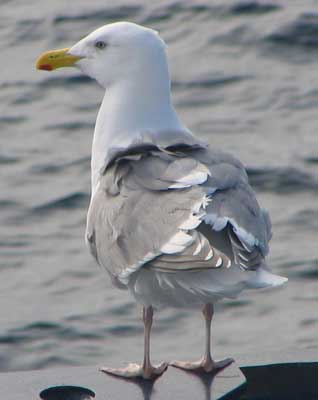
Common Name: Glaucous-winged Gull
Scientific Name: Larus glaucesens
Description
Bulkier gull. Head, neck, chest, upperparts and tail all white; scapulars and upper wings pale gray. Yellow-orange legs and feet and a yellow to yellow-orange beak. Characteristic red spot on bottom tip of beak.
Glaucous-winged Gulls are widely distributed in coastal areas and are therefore one of our most familiar seabirds. Almost every beach, harbor or fishing boat located anywhere from the state of Washington to the Bering Sea will occasionally have a Glaucous-winged Gull sitting on it, or soaring gracefully above it. Part of the secret to their success is that they are flexible in their choice of foods.
Habitat
Near salt water in bays, estuaries, harbors, city parks, and on beaches, mud flats, dumps, barren islands and open ocean. Rarely found in fresh water. Found in the same habitat year-round.
Diet
Species omnivorous. Diet consists of a wide variety of fish, marine invertebrates, garbage, and carrion.
Identification Tips
- Length: 22 inches
- Large gull
- Very large bill with distinct gonydeal angle
- Flat forehead and large bill give "mean" appearance
Adult Alternate
- Bright yellow bill with red spot at gonys
- Pink legs
- Dark eyes
- White head, neck, breast and belly
- Pale gray mantle
- White tertial crescent
- Pale gray primaries (do not contrast with back) have white tips
- White tail
Adult Basic
Like adult alternate but blurry brown streaking and spotting on head and nape
Juvenile/First-year
- Black bill
- Wholly pale brown body plumage
- Pale brown primaries do not contrast with body plumage
- Pale brown tail does not contrast with back
- Black legs quickly become pink
Second-year:
- Black bill with pink base
- Pale brown head, neck, upper breast, belly, primaries and tail
- Pale gray back
Third-year
Like adult basic, but often lacks adult bill pattern, wing pattern, and often retains a partial tail band
Similar Species
Adults of all other species have primaries that contrast with the back color. Glaucous-winged is one of the largest and "meanest-looking" gulls and can often be distinguished just by shape. Young birds also show no contrast between the body and primaries. First-winter plumage is very similar to Thayer' Gull, which has slightly darker primaries and secondaries and a smaller bill (with shallower gonydeal angle), rounder head and smaller size. Glaucous-winged and Western gulls hydridize extensively so beware of intermediate-plumaged hybrids.

 Deep Sea Crabs
 Deep Sea Shrimps
 Deep Sea Lobsters