Lamington Spiny Crayfish
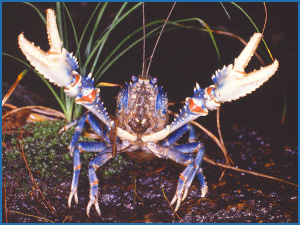
Common Name: Lamington Spiny Crayfish
Scientific Name: Euastacus Sulcatus
Lamington Spiny Crayfish : Description
Grows up to 24cm in length. The typical colour form restricted to the Lamington Plateau is an eye-catching vivid blue or blue-green with patches of white on the carapace and bright red on the joints. Males have larger claws than females, while females have broader abdomens than males.
Lamington Spiny Crayfish : Diet
The Lamington Spiny Crayfish are bottom-dwelling opportunistic scavengers. A large part of their diet consists of rotting leaves and other decomposing plant material.
Lamington Spiny Crayfish : Behaviour
Individuals are commonly seen in summer but remain hidden in crevices or burrows in winter. When they are threatened, the crayfish rear up defensively, hiss and wave and clack their claws aggressively.
Lamington Spiny Crayfish : Habitat
The Lamington Spiny Crayfish is found in pools and streams at altitudes above 300m in subtropical rainforests and wet sclerophyll forest. They also commonly move about the rainforest floor when it is damp in search of food and are sometimes seen considerable distances from the nearest stream.
Lamington Spiny Crayfish : Life History
Eggs are laid in November and December - the female carries the eggs under her tail. The yolk of the egg is retained by the young hatchlings as a yolk sac, supplying food during early growth. The mother's swimmerets move gently to provide a supply of well-aerated water necessary for the survival of the developing young. Only when the yolk sac has been completely absorbed and the young resemble miniature adults, do they leave the mother and commence free living.
Lamington Spiny Crayfish : Location or Region Found
Restricted to south-east Queensland and far northern NSW, including the Lamington Plateau, McPherson Range, Cunningham's Gap, Mistake Mountains and Mt Tamborine.

 Deep Sea Crabs
 Deep Sea Shrimps
 Deep Sea Lobsters