Humphead Wrasse
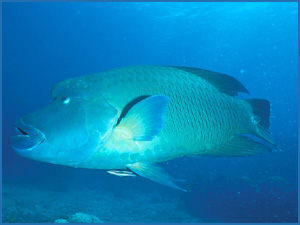
Common Name: Humphead Wrasse
Scientific Name: Cheilinus Undulatus
Humphead Wrasse : Description
The Humphead Wrasse can be recognised by its colour, pattern and shape. The colouring varies with age and sex. They have thick fleshy lips and a hump that forms on the head above the eyes. The hump becomes more prominent with age. The Humphead Wrasse is generally bright electric blue to a duller blue/green, green or purplish blue. Juveniles and females are red-orange above and red-orange to white below. Mature males develop a black stripe along the sides, blue spots on each of the body scales and blue scribbles on the head.
Humphead Wrasse : Diet
Humphead Wrasse mainly eat during the day and can be seen feasting on shellfish, crushing the shells to get to the animal within, fish, sea stars, sea urchins and crabs. They crush large chunks of dead coral rubble with peg-like teeth to feed on the burrowing mussels and worms.
Humphead Wrasse : Behaviour
Humphead Wrasse mainly feed during daylight hours and individuals rest at night below large boulders or in crevices.
Humphead Wrasse : Habitat
Humphead Wrasse is mainly found on coral reef edges and drop-offs. Juveniles can be found among branching corals in shallow lagoons while adults prefer the upper margins of clear lagoon pinnacles and steep coral slopes to at least 100m, but occasionally up to 160m depth. Humphead Wrasse move into shallow bays during the day to feed. They tend to move into deeper waters as they grow older and larger. Adults, therefore, are more common offshore than inshore.
Humphead Wrasse : Life History
The Humphead Wrasse reaches a very large size. A specimen of 229cm in length and weighing 190.5 kg has been recorded, although this remains to be confirmed. Females reach maturity at 50 cm in length.
Humphead Wrasse : Special Features or Habits
The Humphead Wrasse is one of the few predators of toxic animals such as Sea Hares, Boxfish and Crown-Of-Thorns Starfish. Humphead Wrasse change sex from female to male. The factors that control the timing of sex change are not yet known.
Humphead Wrasse : Location or Region Found
This species ranges throughout Great Barrier Reef waters northward to Papua New Guinea and westward through reef waters of the Indo-Pacific region.

 Deep Sea Crabs
 Deep Sea Shrimps
 Deep Sea Lobsters