Cumberland Club 2007(From June 18-29)
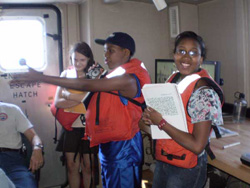
the Hampton Roads Naval Museum (HRNM) and the National Oceanic and Atmospheric Administration (NOAA) held a summer enrichment program, giving students the opportunity to experience being a historian, archeologist and marine-scientist. Named the "Cumberland Club" after the shipwreck they would explore, rising 8th grade students primarily from the largely underserved Norfolk Public School system, were selected to participate in the free summer program by writing essays on "Why is history important?"
The grant from the NOAA Ocean Explorer education program has given interested students a once in a life time opportunity to be part of something real. They all want to come back next year as senior members to mentor the new Cumberland Club kids, and are all welcome to attend! We plan to follow up on these kids throughout their scholastic careers, and continue to aid in any way we can, providing them future opportunities to pursue careers in science or history.
USS Cumberland and the Battle of Hampton Roads
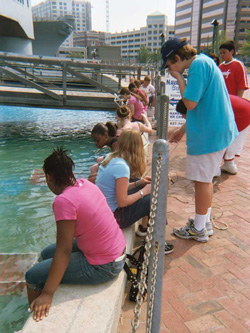
The Cumberland Club anxiously waits in front of Nauticus for the ROV competition to begin. Club members will use their group constructed ROVs in the event.HRNM interns, Matthew Eng and Rebecca Kaczkowski, developed and tested a new pilot program incorporating bathymetry and multibeam technology for the Cumberland Club. The interns created an imaginary shipwreck including log books, and a fictional background story. Students were split into groups; each received a quarter of the fictional multibeam image. Using clay, the students created a three dimensional model of the multibeam image. Then putting all four sections together, students analyzed the log books and background information to try and determine the fate of the sunken ship.
Nearly a year into the American Civil War, the USS Cumberland was moored off Newport News Point. On March 8, 1862 Cumberland met Confederate Iron-clad, CSS Virginia for the first and last time.
After exchanging broadsides with the wooden ship, the CSS Virginia succeeded in ramming her enemy, the USS Cumberland. With her ram stuck inside of the doomed ship, the Virginia feared it too would be brought down with the sinking sloop. The gun crews of the Cumberland gallantly continued firing, even as the ships destruction became inevitable. The ship, still containing the dislodged Virginia's ram, settled in 65 ft. of water, and atop the masts, the United States Flag still flew triumphantly above water.
CSS Virginia continued to decimate the Union's wooden warships in Hampton Roads until the next day, March 9th, when the USS Monitor appeared; Virginia had met her match. The Battle between the ironclads Virginia and Monitor forever changed the face of naval warfare. Iron and steam power were now seen as far superior to the wooden, sail powered ships of old.
Artifact Conservation at Naval Station Norfolk
Today, the Cumberland's wreckage is protected by law. All artifacts belong to the US Navy, and the artifact repository is HRNM. During the program, students learned how to document, photograph and assess the condition of Cumberland artifacts to determine which were in need of conservation. Part of the Cumberland Club funding is being used to conserve two artifacts from the wreck. Those pieces were chosen by the students during the project: a grid from the back of one of Cumberland's cannons, and an unidentified artifact with detailed judicial engravings on brass rivets, binding together two pieces of wood
ROV Building and Competition
In addition to artifact conservation, the club worked in teams to build their own remotely operated vehicles (ROVs). Nauticus and NOAA educators, Peter Leighton and Krista Trono, assisted in providing supplies and expertise. After completion, the teams competed against each other in timed trials simulating actual ROV use in underwater archeological expeditions. The ROVs were constructed out of PVC pipes, stereo wire, fish tank motors, model propellers, and of course, duct tape.
National Marine Sanctuaries
NOAA National Marine Sanctuary Program (NMSP) Educator, Krista Trono, gave an in depth lesson about the 14 National Marine Sanctuaries (NMS), featuring the Monitor NMS. The fun and interactive lessons ended with a highly polarized debate between the students about the expansion of the Monitor NMS. Students portrayed various groups impacted by the growth of the Monitor NMS. Among these groups were commercial fishermen, recreational scuba divers, tourism boards, underwater archeologists and other groups that would be impacted by changing the Sanctuary.
Shipwreck Archeology
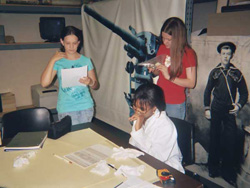
HRNM interns, Matthew Eng and Rebecca Kaczkowski, developed and tested a new pilot program incorporating bathymetry and multibeam technology for the Cumberland Club. The interns created an imaginary shipwreck including log books, and a fictional background story. Students were split into groups; each received a quarter of the fictional multibeam image. Using clay, the students created a three dimensional model of the multibeam image. Then putting all four sections together, students analyzed the log books and background information to try and determine the fate of the sunken ship.
Monitor Center at the Mariners' Museum
The Mariners' Museum in Newport News, VA hosted the Cumberland Club for a day. Head Conservator Marcie Renner, and Conservator Susanne Grieve gave the students an amazing behind-the-scenes tour of the new Monitor Center and their cutting-edge conservation labs. Susanne also spoke at our Cumberland Club teacher workshop on August 17th. The students were given free time to explore the rest of the Mariners' Museum.
Civil War Sailors and Sailing
During the Cumberland Club, students experienced a reenactment from Tidewater's Marine Life Heritage Association. Alan Mordicca taught the group about life as a Civil Was sailor. The kids learned knot tying and sea shanties. Then they went onboard the sailing ship American Rover for a tour around the harbor. They learned how to operate the rigging from the American Rover crew as they listened to Mr. Mordicca perform shanties with his concertina.
NOAA research vessel the Bay Hydrographer
From left to right: Jenny G, Emily P and Meghan G present their artifact analysis to the rest of the Cumberland Club at the HRNMannex site in Naval Station Norfolk.Cumberland Club spent the second week onboard the Bay Hydrographer, with only 4 or 5 students fitting onboard the tiny boat each day. Our cruise departed from the NOAA docks in Norfolk, sailed to the wrecksite of the Cumberland, off the Newport News Point pier docks. Once in position over the wrecksite, we all helped lower the side scan sonar into the water. Inside the ship's cabin, computer screens showed the river bottom as it was recorded by the side scan sonar. All of the data was recorded so that underwater archeologist, Steve Schmidt could mosaic the data together and create a complete image of the wreck. The complete side scan image is used to evaluate the current condition of the shipwreck, providing a "snapshot in time" of the wreck's state on the river bottom. NOAA researchers and crewmen allowed the kids to help drive the boat and control the level of the side scan. The same process was performed with the multibeam sonar, except that the processed images are 3-dimensional and displayed in color rather than 2-dimensional black and white images gathered by the side scan sonar. The resulting mosaiced images showed increased sedimentation over the wreck. This is great news for the wreck of U.S.S. Cumberland, since the sedimentation is protecting it from further damage and deterioration.

 Deep Sea Crabs
 Deep Sea Shrimps
 Deep Sea Lobsters